Using art for research impact
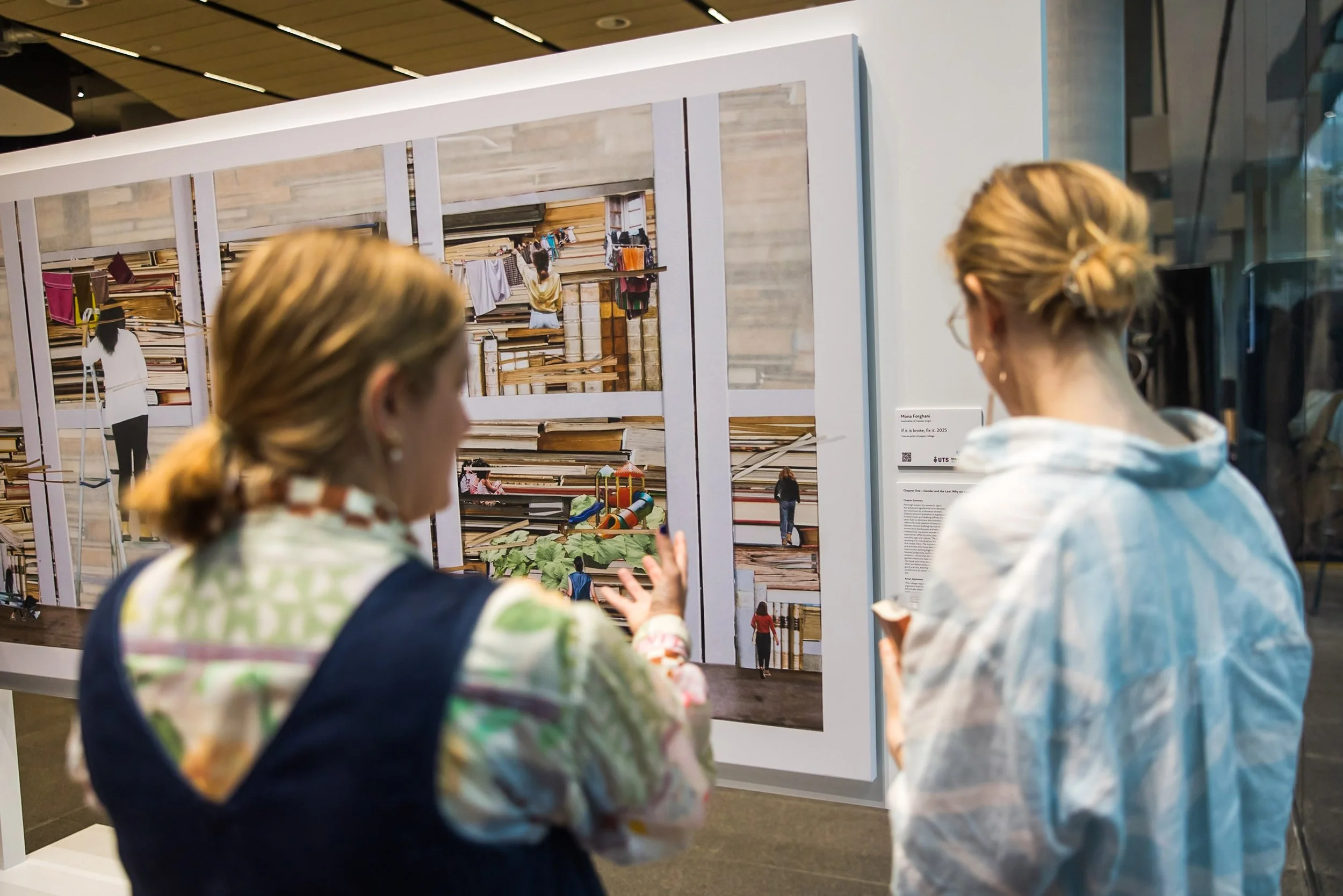
Art has long offered a way to translate complex or seemingly distant ideas into something that resonates more deeply with the public. Legal debates—particularly those around lawmaking and legislative design—are often viewed as impenetrable or abstract. This exhibition responds to that challenge, using art to transform legal research into experiences that are felt as much as understood. Through visual language, the works make legal concepts tangible, prompting exhibition-goers to reflect, question and ultimately support more responsive policy and legislative reform.
For many, the very foundations of law were built in an era when women were largely absent from the drafting table. For some of the law’s biggest critics, women in all their diversity continue to be required to fit their experiences into a pre-determined frame. In contrast, from Forghani’s collage to Valenzuela’s ceramics, colour, texture, fluidity and provocation push back against the law’s rigid lines. These works offer alternative forms of seeing—ones capable of holding uncertainty, contradiction and nuance.
At its core, art is a conduit for empathy. It allows us to inhabit perspectives beyond our own. This is true whether in the literal call for fathers to be empowered to ‘Be There’ in Awan’s film, or in the atmospheric, abstract animation through which Ferris depicts the gendered dynamics of modern slavery. Both works invite viewers to feel the human stakes behind legal questions.
Participatory elements amplify this emotional connection. In Come into my World, visitors can turn the pages of Doran’s book and look—quite literally—into the worlds of women small-scale miners. Kowald, in turn, confronts us with forms of virtual abuse whose real-world consequences we are only beginning to grasp.
Collaboration with artists extends far beyond aesthetics. For many of these artists, drawing becomes a form of inquiry—a way to challenge assumptions, reveal overlooked truths and inspire change. This ethos is captured in the deceptively simple, yet powerful message crafted by the young students from the International Grammar School, urging us to make play fair.
Art also traverses cultural boundaries, inviting viewers to enter experiences that may be far removed from their own. It does not simply inform; it shifts perspective. In Tori-Jay’s work, we encounter an alternative expression of the status quo—rooted in the lived experiences and strengths of the women of the Torres Strait.
This exhibition celebrates the synergy that emerges when creative practice meets rigorous research. Together, they push beyond the traditional edges of both law and academia. With Rewriting the Rules, it is hoped that the fusion of art and scholarship will not only provoke reflection but also help catalyse meaningful social and legislative change.
View references: Art for Impact Reference List
About the Commissioner
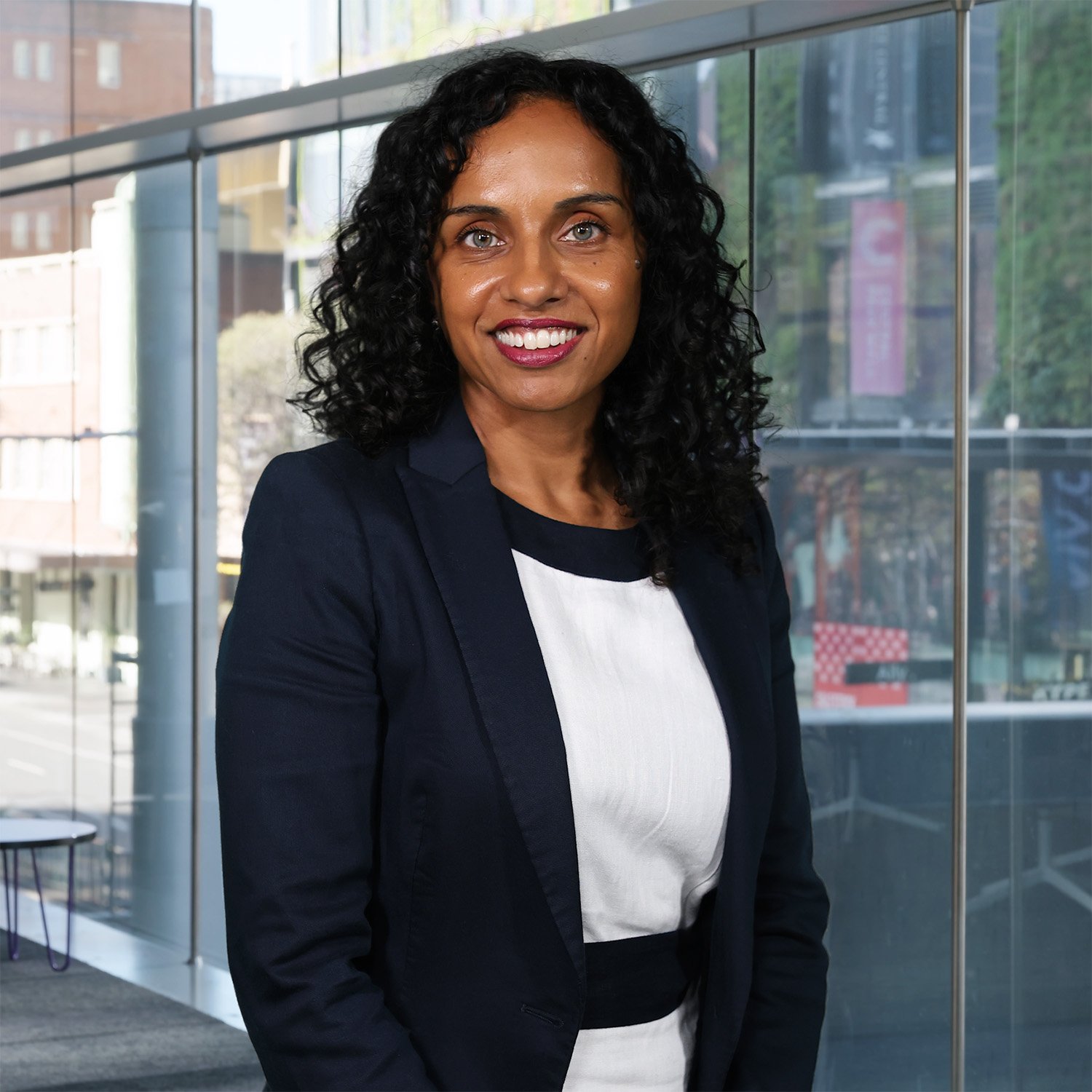
Professor Ramona Vijeyarasa is a scholar of gender and the law. As a practitioner, activist and legal academic, she has travelled the world for her work. This privileged experience drives her pursuit of scholarship that can deliver tangible change to improve lives through the law. Prof. Vijeyarasa’s keen interest in translating the words she puts on the page into real world impact has been a major driver behind this exhibition.
Acknowledgements
There were many people who had a hand in the creation of this exhibition. We offer our thanks:
To our primary funders, the Women’s Leadership Institute of Australia and the Trawalla Foundation, in particular Carol Schwartz AO, Sarah Buckley and Tessa Zajac.
To the UTS Deputy Vice-Chancellor for Research and the UTS Research Translation Advisory Committee, for additional financial assistance and to all colleagues who assisted with fundraising, including Jude Amalraj, Sarah Angus, Maxine Evers, Venus Khalessi, Annamari Laaksonen and Catherine McElhone
To Venus Khalessi and Monir Rowshan, whose initial conversation sowed the seeds for this exhibition
To colleagues, friends and family who provided advice and assistance in identifying artists, installers and other essential providers, including Isabella Alexander, Simon Buckingham-Shum, Marcelle Burns, Venus Khalessi, Nikki Lengkeek, June Miskell, Jasmin Rasiah, Mina Roces and Alex Weight
To Rapido Social Impact for their generous low-bono/pro-bono contributions
To the Center for Social Justice and Inclusion, for support with project planning and outreach, particularly Amy Persson and Fiona Versey
To the Faculty of law, and senior leaders Anita Stuhmcke, Tracey Booth and Shaunnagh Dorsett for support and advice and Executive Assistants Micah Hawkins and Debbie Paulides for their help with delivery of the artwork and Aline Roux for setting up supplier agreements
To Mary Duma and Lucia Langen from the International Grammar School, for helping to facilitate the students’ involvement
To Wendy Lam for research assistance.
To Elizabeth Miller and Catharine Pruscino for advice on content warnings to ensure a safe and empowering experience
To Stella McDonald, Curator and Manager of the UTS Gallery and Art Collection, for lending her expertise, particularly on curation
To our installer Benita Laylim and Duncan Harrex for the design and creation of display supports and the team at Mister Wallpaper
To Steph Yamey, for designing and developing the digital catalogue
To our photographers, the team at Bose Creatives and videographers, Armin Awan and colleagues
To the UTS AVS Team who have enabled the showing of two incredible films
With special thanks owed:
To Willow Ferris for exceptional support with the exhibition logistics
To the entire team at UTS Events, for their support for both the official opening of the Exhibition and the launch of Rewriting the Rules: Gender-Responsive Lawmaking for the Twenty-First Century, particularly Emma Holliday, Amanda Lukac, Julie McAlonana, Shahnam Roshan, Meagan Solomon and Helena Woo
To José-Miguel Bello y Villarino, for overall help at every stage, from conception to realisation
And of course, to all the artists who got involved in the project.